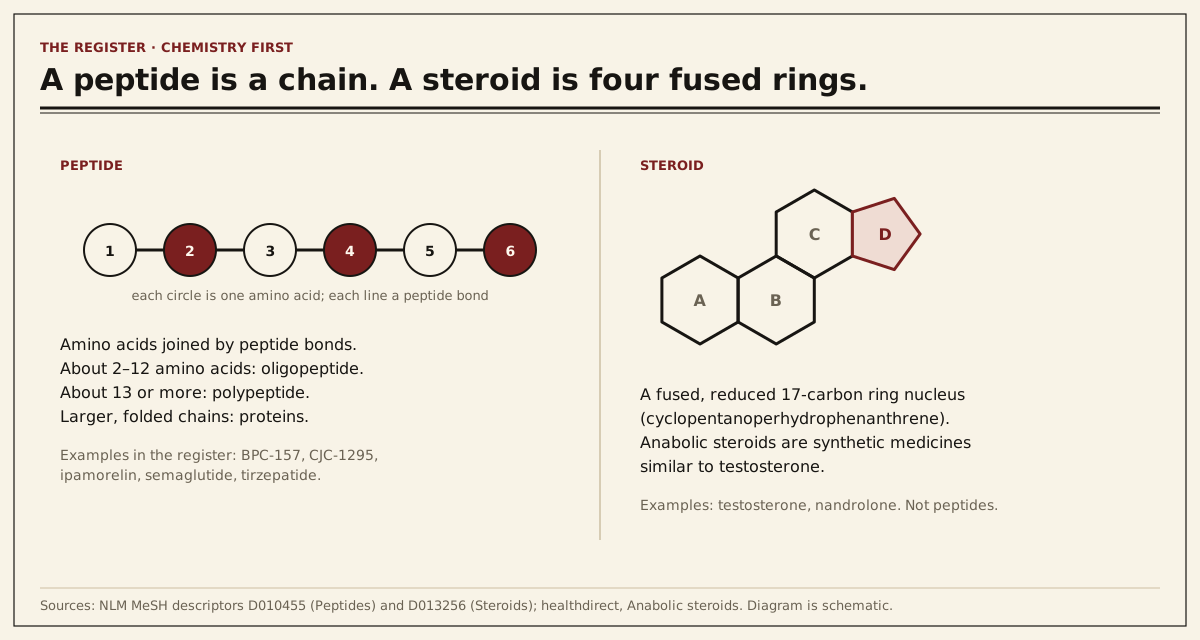
Peptides are not steroids. A peptide is a chain of amino acids joined by peptide bonds, and a steroid is a molecule built on a fused, four-ring carbon nucleus; the two families are built differently and are named separately in Australian law, even though both are sold for muscle and recovery and both are banned in sport.
The confusion is understandable. The same websites sell both, the same gym conversations cover both, and in the Poisons Standard the most talked-about examples of each sit side by side in the same possession control. This report separates the chemistry from the law, then shows where the two meet: the Poisons Standard, the Customs permit list and the WADA Prohibited List.
The chemistry in two definitions
The US National Library of Medicine’s subject vocabulary defines peptides as compounds “composed of amino acids joined together by peptide bonds between adjacent amino acids into linear, branched or cyclical structures”. Chains of about 2 to 12 amino acids are oligopeptides, about 13 or more are polypeptides, and proteins are larger versions that fold into complex structures (MeSH: Peptides). The TGA uses the short form: “peptides are short chains of amino acids, which are the building blocks of proteins” (TGA).
Steroids, in the same vocabulary, “have a common nucleus, a fused, reduced 17-carbon atom ring system, cyclopentanoperhydrophenanthrene”, usually with two methyl groups and a side chain attached. The class includes cholesterol, many hormones, bile acids and certain drugs (MeSH: Steroids).
The anabolic steroids people usually mean are, in healthdirect’s words, “synthetic (human-made) medicines that are similar to the male hormone testosterone”, formally called anabolic-androgenic steroids. Healthdirect also notes they are different from corticosteroids, the anti-inflammatory medicines used for conditions such as arthritis or asthma, although both get called “steroids” (healthdirect).
Where the line blurs
Three things make peptides and steroids look like one category.
- Marketing. The TGA says peptide products are promoted online “for weight loss, muscle growth, anti-ageing, recovery and performance enhancement” (TGA), the same claims made for steroids.
- Hormones that are peptides. Some of the hormones involved in muscle growth are themselves peptides or proteins: Sport Integrity Australia lists somatropin, the medicine form of growth hormone, among registered therapeutic peptides (Sport Integrity Australia).
- Products that are neither. Ibutamoren, sold as MK-677, is often grouped with peptides but is an orally active, non-peptide growth hormone secretagogue (Codner et al., 2001; Sport Integrity Australia). It is not a steroid either.
How Australian law treats each
For legal purposes the chemistry matters less than the schedule entry. Both families appear in the same part of the Poisons Standard.
| Question | Anabolic steroids | Peptides such as BPC-157, CJC-1295, TB-500 |
|---|---|---|
| Poisons Standard | Schedule 4; “anabolic steroidal agents” and “androgenic steroidal agents” are items 1 and 2 of Appendix D, clause 5 | Schedule 4; BPC-157, CJC-1295, TB-500, thymosin beta 4 and others are named in Appendix D, clause 5 |
| Possession without authority | Illegal under clause 5 | Illegal under clause 5 |
| Import permit (Customs Schedule 7A) | Yes: “anabolic or androgenic substances” | For some peptide hormones: gonadotrophins including hCG, growth hormones, and growth hormone releasing hormones and their synthetic analogues |
| Approved products | Some, on prescription for medical conditions (healthdirect) | None for BPC-157, TB-500, CJC-1295 or ipamorelin |
| Sport (WADA 2026) | S1 anabolic agents | S0 (BPC-157) or S2 (growth hormone releasing factors, growth factors) |
Sources for the table: Poisons Standard, Appendix D; Customs (Prohibited Imports) Regulations, Schedule 7A; WADA 2026 List.
Healthdirect says it is “only legal to take anabolic steroids in Australia if they have been prescribed by a doctor for a medical purpose”, that penalties for supply vary by state and territory, and that “in some states, they are classified in the same drug category as heroin or ice” (healthdirect). How each state classifies individual peptides varies, so the national standard is the starting point rather than the last word.
Other look-alikes: SARMs
Selective androgen receptor modulators, sold as SARMs, are a third group that often appears beside peptides and steroids in the same online shops. They have their own group entry, item 33, in Appendix D, clause 5: “selective androgen receptor modulators (SARM), including those separately specified in Schedule 4” (Poisons Standard). WADA lists them under S1 with the anabolic agents, naming andarine, enobosarm (ostarine), LGD-4033, RAD140, S-23 and YK-11 as examples (WADA 2026 List).
The pattern is consistent. The scheduling delegate must weigh “the potential for abuse of a substance” among the matters in section 52E of the Therapeutic Goods Act, and the substances sold for muscle and performance, whatever their chemistry, have ended up under the same possession control.
In sport
WADA keeps the two families in separate sections of the 2026 Prohibited List. Anabolic agents are S1. Peptide hormones, growth factors, related substances and mimetics are S2, which covers, among others, chorionic gonadotrophin in males, growth hormone and its fragments, GHRH analogues such as CJC-1295, secretagogues such as ipamorelin and ibutamoren, GH-releasing peptides such as GHRP-6, and thymosin-β4 and its derivatives such as TB-500. BPC-157 is named separately under S0, non-approved substances. All are prohibited at all times.


Sport Integrity Australia lists BPC-157, CJC-1295, GHRP-2, GHRP-6, hexarelin, ibutamoren, ipamorelin and thymosin beta-4 alongside steroids such as nandrolone, stanozolol and testosterone in its non-exhaustive list of substances that have led to positive tests and sanctions (Sport Integrity Australia). It also warns that products sold as peptides may be contaminated with other prohibited substances (Sport Integrity Australia).
What is in the vial may be neither
The TGA’s September 2026 retatrutide alert is a reminder that the label is not the contents: a vial sold as one peptide held a different drug entirely (TGA). Peptide Testing Australia has written about the risks of buying peptides online, including mislabelling. For the legal position on any single peptide, start with the register.
Questions readers ask
Is BPC-157 a steroid?
No. It is a peptide. Like anabolic steroids, though, it is a Schedule 4 medicine in Appendix D, clause 5, so possessing it without authority is illegal.
Is growth hormone a steroid?
No. Growth hormone is a peptide hormone; Sport Integrity Australia lists somatropin among registered therapeutic peptides. It is in Schedule 4 and Appendix D, clause 5, and needs a Customs permit to import.
Is MK-677 a peptide or a steroid?
Neither. Ibutamoren (MK-677) is an orally active, non-peptide growth hormone secretagogue. It is in Schedule 4 and Appendix D, clause 5, and banned in sport under S2.
Are peptides as illegal as steroids?
Nationally, the peptides named in Appendix D, clause 5 carry the same possession control as anabolic steroids. Penalties are set by each state and territory and can differ between the two.
Sources
- NLM MeSH: Peptides (D010455)
- NLM MeSH: Steroids (D013256)
- TGA: Peptide products
- healthdirect: Anabolic steroids
- Sport Integrity Australia: Peptides explained
- Sport Integrity Australia: Ibutamoren (MK-677)
- Codner et al., Clin Pharmacol Ther 2001: ibutamoren, a nonpeptide GH secretagogue
- Poisons Standard, October 2026 (F2026L01327)
- Customs (Prohibited Imports) Regulations 1956
- WADA Prohibited List 2026
- Sport Integrity Australia: Substances banned in sport
- TGA safety advisory, 14 September 2026: counterfeit retatrutide