BPC-157 is not legal to buy, sell or hold in Australia without proper authority. Since 1 June 2024 it has been a Schedule 4 prescription-only medicine listed in Appendix D, clause 5 of the Poisons Standard, which makes possession without authority illegal, and there is no BPC-157 product on the Australian Register of Therapeutic Goods (ARTG) that a doctor could prescribe in the ordinary way.
That position is recent. Before mid-2024 BPC-157 was not named in the Poisons Standard at all, so older material online may still describe it as unregulated. This report sets out what changed, what each part of the law does, and where BPC-157 stands in sport.
What the Poisons Standard says
The October 2026 edition of the Poisons Standard lists “BPC-157” in Schedule 4, the schedule for prescription-only medicines, marked to show it also appears in Appendix D. In Appendix D it is item 5 in clause 5, the table of “poisons for which possession without authority is illegal”. The clause says those poisons “must not be possessed by a person without authority (for example, possession other than in accordance with a legal prescription)”.
The explanatory statement that accompanied the change put it the same way: the new entries “provide that these substances are prescription-only medicines, possession of which without authority (e.g., other than in accordance with a legal prescription) is illegal” (explanatory statement, June 2024). Capromorelin, another growth hormone secretagogue, was scheduled at the same time with the same controls.
| Question | Position at 5 November 2026 | Source |
|---|---|---|
| Poisons Standard schedule | Schedule 4, prescription only | Poisons Standard |
| Possession without authority | Illegal (Appendix D, clause 5, item 5) | Poisons Standard |
| Approved product on the ARTG | None | Sport Integrity Australia |
| In force since | 1 June 2024 | explanatory statement |
| Sport | Prohibited at all times (WADA S0) | WADA 2026 List |
How BPC-157 came to be scheduled
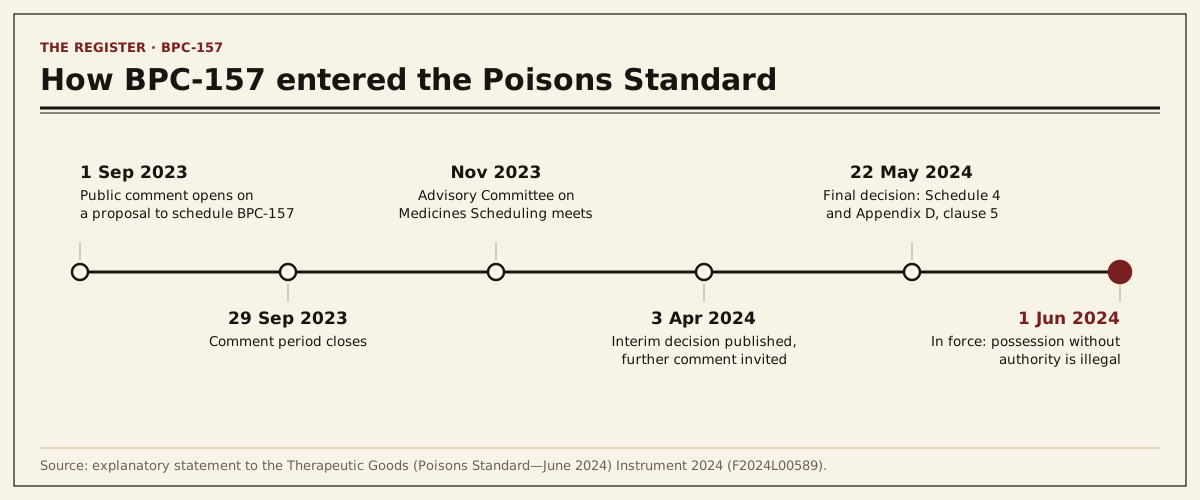
The scheduling followed the usual public process. According to the explanatory statement, an invitation to comment on a proposal “to create new entries for BPC-157 in Schedule 4 and Appendix D, clause 5” was published on the TGA website on 1 September 2023 and closed on 29 September 2023. The proposal went to the November 2023 meeting of the Advisory Committee on Medicines Scheduling. An interim decision was published for further comment on 3 April 2024, the final decision followed on 22 May 2024, and the Therapeutic Goods (Poisons Standard—June 2024) Instrument 2024 commenced on 1 June 2024.
The entries remain in the October 2026 standard, which commenced on 1 October 2026. Our report on how the TGA schedules peptides explains each step of that process and why the states and territories, rather than the Commonwealth, give the schedule its force.
Is there an approved BPC-157 product?
No. Sport Integrity Australia says BPC-157 is not listed on the ARTG and describes it as “an experimental peptide that is not approved for use by any regulatory agency worldwide” (Sport Integrity Australia). The TGA named BPC-157 first in its April 2026 list of examples of unapproved peptide products, “often supplied in injectable form” (TGA advisory).
That matters because of how the Therapeutic Goods Act works. The TGA says peptide products regulated as therapeutic goods “must be included in the Australian Register of Therapeutic Goods (ARTG) before they can be imported, manufactured, supplied, exported or advertised”, with limited exceptions for specific approvals, authorities or exemptions (TGA). Being in Schedule 4 sets the level of control; it is not an approval.
Can a doctor prescribe BPC-157?
The legal pathways for an unapproved medicine are narrow. The TGA says that “in limited circumstances, health practitioners may be able to access an unapproved therapeutic good for a patient through established access pathways”, and that this “should only occur after clinically appropriate treatment options included in the ARTG have been considered” (TGA).
Compounding is also constrained. The TGA’s April 2026 advisory says a compounded good is generally only exempt from ARTG inclusion where it is “dispensed or extemporaneously compounded for a particular person for application to that person”, or compounded in a hospital in anticipation of patient need, and that practitioners must also meet their professional standards, including those set by Ahpra (TGA advisory). Sport Integrity Australia adds that a medicine made by a compounding pharmacy “may not be approved by the TGA and would be considered an unregistered medicine” (Sport Integrity Australia).
Importing BPC-157
Because BPC-157 is a prescription-only medicine, the Personal Importation Scheme would require a valid Australian prescription or written authority held at the time of import, among its other conditions. The TGA has also said that vials “identified only by codes, or those that do not clearly state the active ingredient, strength or dosage” cannot be assessed under the scheme “and will not be considered for release”, and that a “research use only” label does not permit importation (TGA advisory). Goods that do not comply may be seized and destroyed. The wider legal position is in our report on bringing peptides into Australia.
BPC-157 in sport
The WADA 2026 Prohibited List names BPC-157 under S0, non-approved substances, a class that covers any pharmacological substance “with no current approval by any governmental regulatory health authority for human therapeutic use”. S0 substances are prohibited at all times, in and out of competition. Sport Integrity Australia says a Therapeutic Use Exemption “would not be granted” for BPC-157 for any medical condition, and lists BPC-157 among substances that have resulted in positive tests and sanctions (substances banned in sport).
What a vial label can and cannot tell you
The TGA warns that the labelling of unapproved peptide products “may be inaccurate or misleading”, and its adverse event reports for these products include severe allergic reactions requiring adrenaline and hospital treatment (TGA advisory). Sport Integrity Australia says “there are currently no studies investigating BPC-157’s use in human subjects” and that “the safety of both its short-term and long-term intake is unknown” (Sport Integrity Australia).
For anyone who already holds a vial labelled BPC-157 and wants to know what it actually contains, Peptide Testing Australia checks identity and purity for samples posted within Australia. A laboratory result describes the contents; it does not change the legal position set out above.
Questions readers ask
Is it illegal to possess BPC-157 in Australia?
Yes, without authority. BPC-157 is in Appendix D, clause 5 of the Poisons Standard, which says the listed poisons must not be possessed without authority, for example other than under a legal prescription. State and territory laws apply the standard and set the penalties.
Can I buy BPC-157 legally in Australia?
There is no approved BPC-157 product on the ARTG, and the Therapeutic Goods Act prohibits supplying unapproved therapeutic goods unless an exemption applies. As a Schedule 4 medicine it also requires a prescription. This paper does not cover sources or suppliers.
Is BPC-157 a steroid?
No. BPC-157 is a peptide, a short chain of amino acids, while steroids are built on a four-ring carbon skeleton. Both, however, appear in Appendix D, clause 5. See are peptides steroids?
Is BPC-157 banned in sport?
Yes. WADA lists it by name under S0, non-approved substances, which are prohibited at all times, and Sport Integrity Australia says no Therapeutic Use Exemption would be granted for it.
Sources
- Poisons Standard, October 2026 (F2026L01327)
- Explanatory statement, Poisons Standard June 2024 (F2024L00589)
- Therapeutic Goods Act 1989
- TGA: How we regulate therapeutic peptide products
- TGA safety advisory, 13 April 2026: responsibilities for unapproved peptide products
- TGA: Personal Importation Scheme
- Sport Integrity Australia: BPC-157
- Sport Integrity Australia: Peptides explained
- Sport Integrity Australia: Substances banned in sport
- WADA Prohibited List 2026