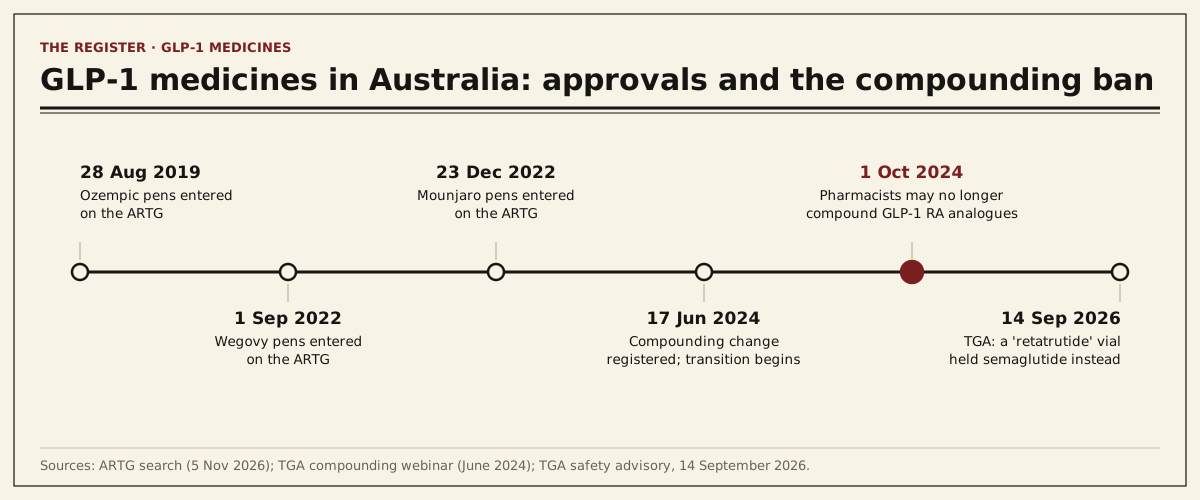
Ozempic, Wegovy and Mounjaro are legal in Australia when a doctor prescribes them and a pharmacist dispenses them. All three are approved products on the Australian Register of Therapeutic Goods (ARTG), their active ingredients semaglutide and tirzepatide are Schedule 4 prescription-only medicines, and since 1 October 2024 pharmacists have not been allowed to compound medicines containing GLP-1 receptor agonist analogues.
This report uses brand names because that is how most people search. The legal entries are for the active ingredients: the Poisons Standard schedules semaglutide and tirzepatide, not the products, and the ARTG lists each brand, strength and device as a separate entry. Where the two differ, the ingredient entry decides the schedule and the product entry decides whether it can be supplied.
The approved products
An ARTG search on 5 November 2026 returned the following earliest entries:
| Product | Active ingredient | Sponsor | Earliest ARTG date shown |
|---|---|---|---|
| Ozempic pens | Semaglutide | Novo Nordisk | 28 August 2019 (search) |
| Wegovy pens | Semaglutide | Novo Nordisk | 1 September 2022 (search) |
| Mounjaro pens | Tirzepatide | Eli Lilly | 23 December 2022 (search) |
| Saxenda pen | Liraglutide | Novo Nordisk | 24 December 2015 (search) |
Later entries cover other presentations, including Mounjaro KwikPens from 19 June 2024 and Wegovy semaglutide tablets entered on 3 November 2026. The TGA describes Ozempic, Wegovy, Mounjaro and Trulicity as registered GLP-1 receptor agonist products, and notes that Ozempic and Wegovy contain the same active ingredient but “have different approved indications and uses, as well as different dosages and devices” and are not interchangeable (TGA webinar).
Prescription only
Semaglutide, tirzepatide, liraglutide and dulaglutide are each listed in Schedule 4 of the Poisons Standard. None is in Appendix D, clause 5. Schedule 4 means supply on the prescription of an authorised prescriber, through a pharmacist. Advertising prescription-only medicines to the public is prohibited unless an Australian government authority authorises or requires it (TGA).
The 2024 compounding ban
During the GLP-1 shortages, compounding pharmacies made semaglutide-like products at scale. The TGA moved to stop it. The new rule was registered on 17 June 2024 as an amendment to Schedule 5, item 6 of the Therapeutic Goods Regulations 1990, followed by a transition period to 30 September 2024. From 1 October 2024, in the words of the TGA’s Chief Medical Adviser, “compounding of GLP-1 receptor agonists will no longer be permitted, and that includes all dosage forms” (TGA webinar).
The current regulation still carries the exclusion. Item 6 exempts medicines “dispensed, or extemporaneously compounded, for a particular person” from ARTG inclusion, “other than” several categories, including “(c) medicines that contain glucagon-like peptide-1 (GLP-1) receptor agonist analogues” (Therapeutic Goods Regulations, Schedule 5). The TGA says the amendments apply to all medicines containing GLP-1 RA analogues, regardless of dosage form, compounded on or after 1 October 2024 (TGA).
The TGA’s stated reasons were the unknown nature and safety of imported raw ingredients, the absence of any regulatory evaluation for safety and quality, compounding at a scale beyond the individual-patient basis of the exemption, and the lack of adverse event reporting (TGA webinar). It warned that civil and criminal penalties may apply to anyone who unlawfully manufactures and supplies compounded GLP-1 products from that date.
The regulation is worded around “GLP-1 receptor agonist analogues”, and the TGA’s material uses semaglutide as its example. We did not find TGA wording that names tirzepatide, a dual GIP and GLP-1 receptor agonist, in connection with the exclusion; a pharmacist or the TGA is the right place to confirm how it applies to a specific product.
Shortages and the approved supply
The compounding change came during a long shortage. At the time, the TGA said it would “continually act to monitor the supply of the registered products, Ozempic, Wegovy, Mounjaro, and Trulicity”, publish shortage updates in its medicine shortage reports database, and that the compounding change was “unlikely to impact the duration of the current shortages”, with supply pressure expected to ease as more products arrived (TGA webinar). Its stated position was that alternatives used during a shortage must meet the TGA’s standards of quality, safety and efficacy, rather than be made up outside the register. A shortage of an approved medicine does not make an unapproved substitute lawful to supply.
Bringing GLP-1 medicines into Australia
Asked whether compounded semaglutide could be imported under the Personal Importation Scheme, the TGA said it could be imported by a patient, but “a prescription would be required” and “would need to be issued by an Australian medical practitioner”, and it advised caution before importing any unapproved medicine (TGA webinar). The scheme’s other conditions also apply, and the TGA says counterfeit medicines are prohibited from import “under any circumstances”, even when the importer holds a prescription (TGA). Our report on bringing peptides into Australia sets out the conditions.
Retatrutide is a different case
Retatrutide, sold online as “reta”, is not an approved medicine anywhere. The TGA says it “is currently undergoing clinical trials in humans and has not been approved by the TGA or any comparable international regulator”, and that “any retatrutide product accessed outside of clinical trials could be a counterfeit product” (TGA, September 2026). It is not named in the October 2026 Poisons Standard, which does not make it lawful to supply: an unapproved therapeutic good still cannot be supplied without an exemption.
The TGA’s alert followed a serious adverse event. A consumer had uncontrollable vomiting that tore their oesophagus. TGA testing of the vial, which was unmarked, found “undeclared semaglutide and no retatrutide”, at about eight times the level in ARTG-listed semaglutide products. Laboratory results like that are the clearest illustration of what a peptide test result can show that a label cannot.
In sport
Sport Integrity Australia says GLP-1 agonists “are currently not prohibited in sport” and that markers of semaglutide and tirzepatide are on the WADA Monitoring Program, which tracks patterns of use. It says retatrutide “is not listed on the Prohibited List”, while warning that counterfeit products could be contaminated with prohibited substances (Sport Integrity Australia).
Questions readers ask
Is compounded semaglutide legal in Australia?
Not since 1 October 2024. Schedule 5, item 6 of the Therapeutic Goods Regulations no longer exempts compounded medicines containing GLP-1 receptor agonist analogues, so pharmacists cannot compound them.
Is Mounjaro TGA approved?
Yes. Mounjaro tirzepatide pens were first entered on the ARTG on 23 December 2022, and later presentations have been added. Tirzepatide is a Schedule 4 prescription-only medicine.
Is retatrutide legal in Australia?
Retatrutide is not approved by the TGA and is only available in clinical trials. It is not named in the Poisons Standard, but as an unapproved therapeutic good it cannot lawfully be supplied without an exemption, and the TGA warns products sold outside trials may be counterfeit.
Can I bring Ozempic into Australia?
Prescription medicines can be imported for personal use only if every Personal Importation Scheme condition is met, including a valid Australian prescription and no more than a three-month supply. Counterfeits are prohibited in all circumstances.
Sources
- ARTG search: “Ozempic”, 5 Nov 2026
- ARTG search: “Wegovy”, 5 Nov 2026
- ARTG search: “tirzepatide”, 5 Nov 2026
- TGA webinar: changes to compounding GLP-1 RA products
- TGA: Update on the GLP-1 RA pharmacy compounding changes
- Therapeutic Goods Regulations 1990, Schedule 5
- Poisons Standard, October 2026 (F2026L01327)
- TGA safety advisory, 13 April 2026: responsibilities for unapproved peptide products
- TGA: Personal Importation Scheme
- TGA safety advisory, 14 September 2026: counterfeit retatrutide
- Sport Integrity Australia: Retatrutide