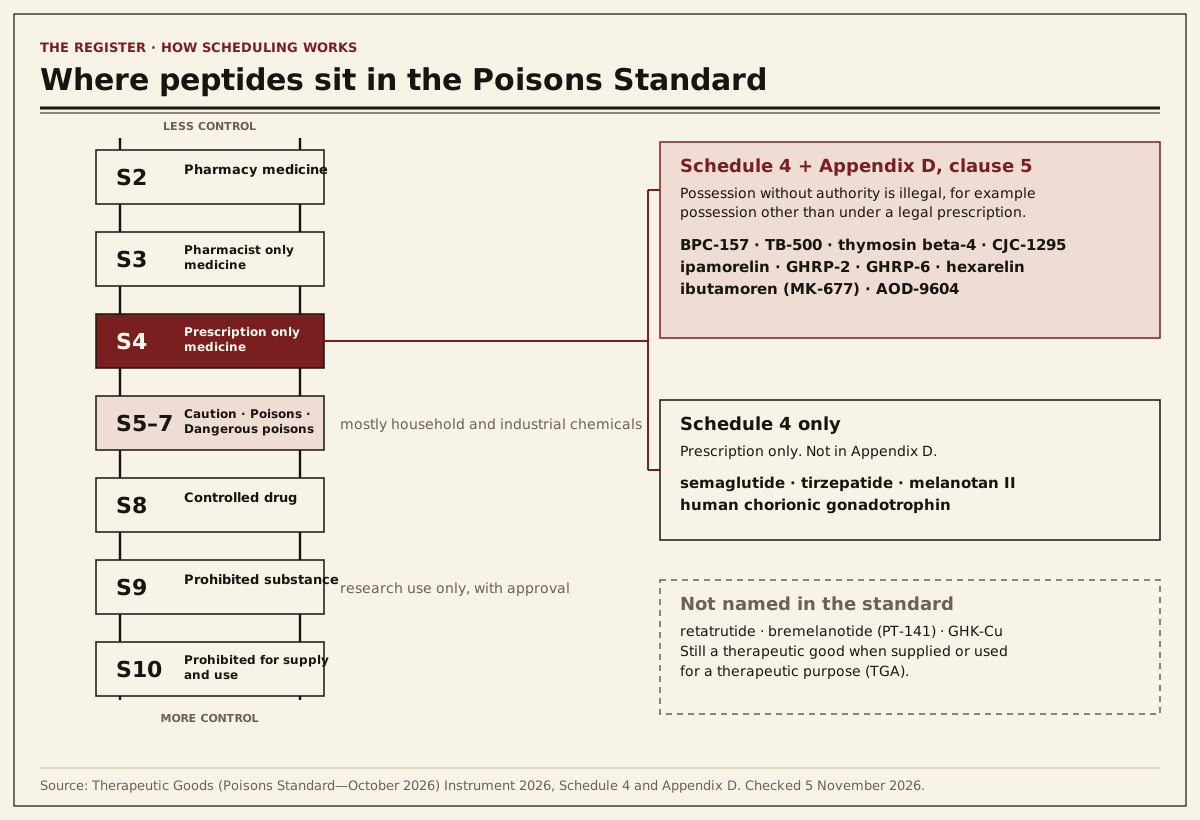
The TGA schedules a peptide by amending the Poisons Standard: a delegate of the Secretary of the Department of Health, Disability and Ageing decides which schedule the substance belongs in, usually after public consultation and advice from the Advisory Committee on Medicines Scheduling. The new entry takes effect when the next edition of the standard commences, and it has legal force because each state and territory applies the standard through its own poisons legislation.
That two-level structure explains most of what puzzles people about peptide law, including why “the TGA has scheduled it” and “it is illegal where I live” are related but different statements.
Who makes the decision
Part 6-3 of the Therapeutic Goods Act 1989 provides for a uniform system of access controls for scheduled substances. Subsection 52D(2) lets the Secretary amend the current Poisons Standard or prepare a document in substitution for it. In practice the power is exercised by a delegate: the October 2026 edition was made by an Assistant Secretary in the department’s Health Products Regulation Group, acting as the Secretary’s delegate (Poisons Standard, October 2026).
Anyone may ask for a change. Section 52EAA allows “a person” to apply to the Secretary for an amendment of the current Poisons Standard, on the approved form and with the prescribed fee.
What the decision-maker must weigh
Section 52E sets the criteria. In exercising the power, the Secretary must take into account, where relevant:
- the risks and benefits of the use of a substance;
- the purposes for which it is to be used and the extent of its use;
- its toxicity;
- the dosage, formulation, labelling, packaging and presentation;
- its potential for abuse; and
- any other matters the Secretary considers necessary to protect public health.
The Secretary must also comply with relevant guidelines of the Australian Health Ministers’ Advisory Council, and “must have regard to any recommendations or advice” of the Advisory Committee on Medicines Scheduling or the Advisory Committee on Chemicals Scheduling (section 52E). The standard’s reader’s guide adds that substances “are not scheduled on the basis of a universal scale of toxicity”; purpose of use, potential for abuse, safety in use and need are weighed as well.
How consultation runs: BPC-157 as the worked example
The scheduling of BPC-157 shows the full sequence, as recorded in the explanatory statement to the June 2024 edition (explanatory statement):
| Step | BPC-157 |
|---|---|
| Proposal published, public comment invited | 1 September 2023, closing 29 September 2023 |
| Expert advisory committee | November 2023 meeting of the Advisory Committee on Medicines Scheduling |
| Interim decision published, further comment invited | 3 April 2024, closing 17 April 2024 |
| Final decision published | 22 May 2024 |
| New edition commences | 1 June 2024 |
The outcome was “a new Schedule 4 and Appendix D, clause 5 entry for BPC-157 and capromorelin”. From proposal to force took about nine months.
Why the states and territories matter
The Poisons Standard is a Commonwealth legislative instrument, but it is not a criminal code. Its reader’s guide describes its scheduling decisions as “recommendations to Australian States and Territories” and says “the scheduling of poisons is implemented through relevant State and Territory legislation” (Poisons Standard).
The June 2024 explanatory statement is more direct: the states and territories regulate scheduled substances “by electing to apply the current Poisons Standard as a law within their own jurisdiction. In this way, the current Poisons Standard does not have direct application in its own right.” For the same reason, Parliament cannot disallow it: subsection 52D(4A) of the Act switches off disallowance because the standard forms part of an intergovernmental scheme (explanatory statement).
So the standard sets the national baseline, and the reader’s guide tells readers that “for the legal definitions… it is necessary to check with each relevant State or Territory authority”.
Named entries and group entries
The standard names substances “individually using their approved names wherever practicable”, but keeps some group entries “to deal with any members of the group or class that may have escaped attention but should be scheduled”. Peptides show both techniques. Ipamorelin, hexarelin, GHRP-6 and CJC-1295 are named individually, and Appendix D, clause 5 also lists growth hormone releasing hormones, growth hormone releasing peptides and growth hormone secretagogues as groups, “including those separately specified in Schedule 4”.
How to follow a proposal
Every step in the process leaves a public record. Invitations to comment, interim decisions and final decisions are published on the TGA website, and each new edition of the standard is registered on the Federal Register of Legislation with an explanatory statement. The explanatory statement is the most useful single document: it lists every substance added or changed, the consultation dates, the advisory committee meeting that considered it and the commencement date, as the June 2024 statement did for BPC-157. Reading the statement for the edition in force tells you what changed and when, without comparing hundreds of pages of schedules line by line.
What the schedules mean
| Schedule | Title | Short description (Poisons Standard) |
|---|---|---|
| S2 | Pharmacy medicines | Safe use may require advice from a pharmacist |
| S3 | Pharmacist only medicines | Need professional advice, available from a pharmacist without prescription |
| S4 | Prescription only medicines | Use or supply by or on the order of an authorised prescriber, from a pharmacist on prescription |
| S8 | Controlled drugs | Restricted manufacture, supply, distribution, possession and use |
| S9 | Prohibited substances | Prohibited except for approved research, analytical, teaching or training purposes |
| S10 | Prohibited for supply and use | Prohibited for the purposes listed for each poison |
Most peptides in our register sit in Schedule 4; several also carry the Appendix D, clause 5 possession control.
Scheduling is not approval
A peptide can be in Schedule 4 with no approved product at all. BPC-157 is the clearest case: scheduled since 2024, still not on the ARTG. Scheduling sets how tightly a substance is controlled. Approval, which is a separate assessment of a particular product, is what allows it to be supplied. Our list of TGA-approved peptide medicines covers that side.
Editions change often. The June 2026 standard replaced the February 2026 edition, and the October 2026 edition repealed and replaced June’s from 1 October 2026. For a plain-English overview of how these rules fit together, Peptide Testing Australia has published a guide to peptide law and the TGA.
Questions readers ask
Does Schedule 4 mean a peptide is approved?
No. Schedule 4 means a substance is a prescription-only medicine. Approval is a separate step in which a particular product is included on the ARTG. BPC-157 is in Schedule 4 but has no approved product.
Is the Poisons Standard a law?
It is a Commonwealth legislative instrument, but its schedules work as recommendations that each state and territory applies through its own legislation. That state law is what makes possession or supply an offence.
Can a peptide’s schedule change?
Yes. Anyone may apply for an amendment under section 52EAA of the Therapeutic Goods Act, and the TGA publishes proposals, interim decisions and final decisions before each new edition commences.
Who decides whether a peptide is scheduled?
A delegate of the Secretary of the Department of Health, Disability and Ageing, under section 52D of the Act, who must weigh the section 52E criteria and have regard to the scheduling advisory committees’ advice.