
Bringing peptides into Australia is lawful only within tight limits. An unapproved peptide can be imported only under an exemption, usually the Personal Importation Scheme, and only if every condition is met, including a valid Australian prescription for a prescription-only medicine; certain hormones also need written permission under the Customs (Prohibited Imports) Regulations, and goods that fail any test can be seized and destroyed.
This report describes the legal position only. It does not explain how to order, ship or carry any substance.
Three sets of rules
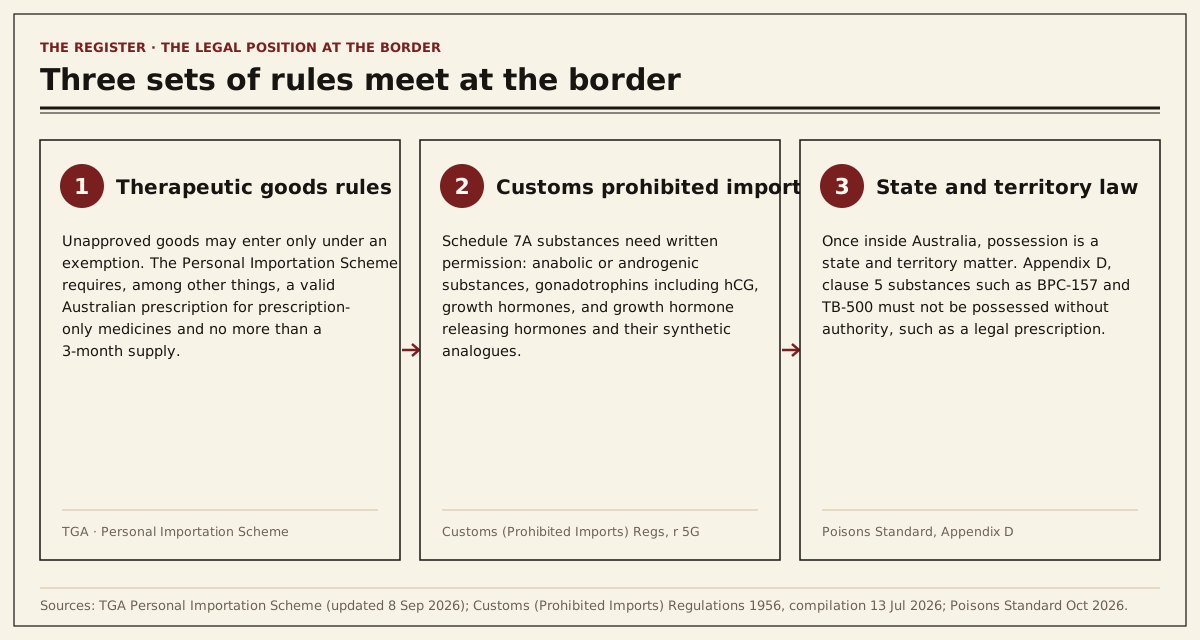
The first is therapeutic goods law. The TGA says unapproved peptide products “cannot be imported or supplied in Australia unless a valid exemption, approval or authority applies”, and that individuals may be able to use the Personal Importation Scheme “but only if all conditions of the scheme are met” (TGA). The second is Customs law, which requires a permit for some substances whatever their therapeutic status. The third applies once a product is in the country: state and territory poisons law, which gives effect to the possession controls in the Poisons Standard.
The Personal Importation Scheme, condition by condition
The TGA’s page, updated on 8 September 2026, says an import is covered only if all of these are met (TGA):
- the products are for the importer’s own use or an immediate family member’s, and are not sold, supplied or given to anyone else;
- for a medicine that is prescription-only in Australia, the importer holds a valid Australian prescription or written authority at the time of importation;
- the import is no more than a three-month supply, and no more than a 15-month supply in any 12 months;
- everything is in its original packaging, or packaging that lets the product be accurately identified.
The import must also not contain a controlled substance, include vaping products, or be prohibited under Customs or quarantine rules. The TGA adds that electronic prescriptions “cannot be accepted as valid written authority for importation”, and that counterfeit medicines are prohibited from import “under any circumstances”.
Most peptides in our register are Schedule 4 medicines, so the prescription condition applies to them. The TGA has made clear that peptides get no special treatment: its April 2026 advisory says individuals importing unapproved peptide products under the scheme “must meet all other conditions of the Scheme, including having an appropriate medical authorisation or prescription when required” (TGA advisory).
The TGA’s own worked examples
The scheme page includes case studies. In one, a member of the public buys a prescription-only medicine from an overseas website without a valid Australian prescription; the package is stopped, assessed by the TGA, treated as unlawful and seized, and “no compensation is provided to the importer”. In another, the buyer holds a prescription, but the medicine is one the TGA has tested and found to be counterfeit; it is seized regardless, because counterfeit products cannot be imported in any circumstances. In the third, a patient with a valid prescription imports a three-month supply that matches the prescription and contains no controlled substance, and the goods are released (TGA).
What the TGA says about peptide parcels
The same advisory sets out how the TGA treats peptide imports in practice. Products “identified only by codes, or those that do not clearly state the active ingredient, strength or dosage” cannot be assessed for lawful importation “and will not be considered for release”. Products “labelled to avoid regulatory scrutiny”, including vials that are unlabelled or over-labelled, are unlikely to be released. And a “research use only” disclaimer does not “change a product’s regulatory status”, “permit importation” or remove supply obligations (TGA advisory).
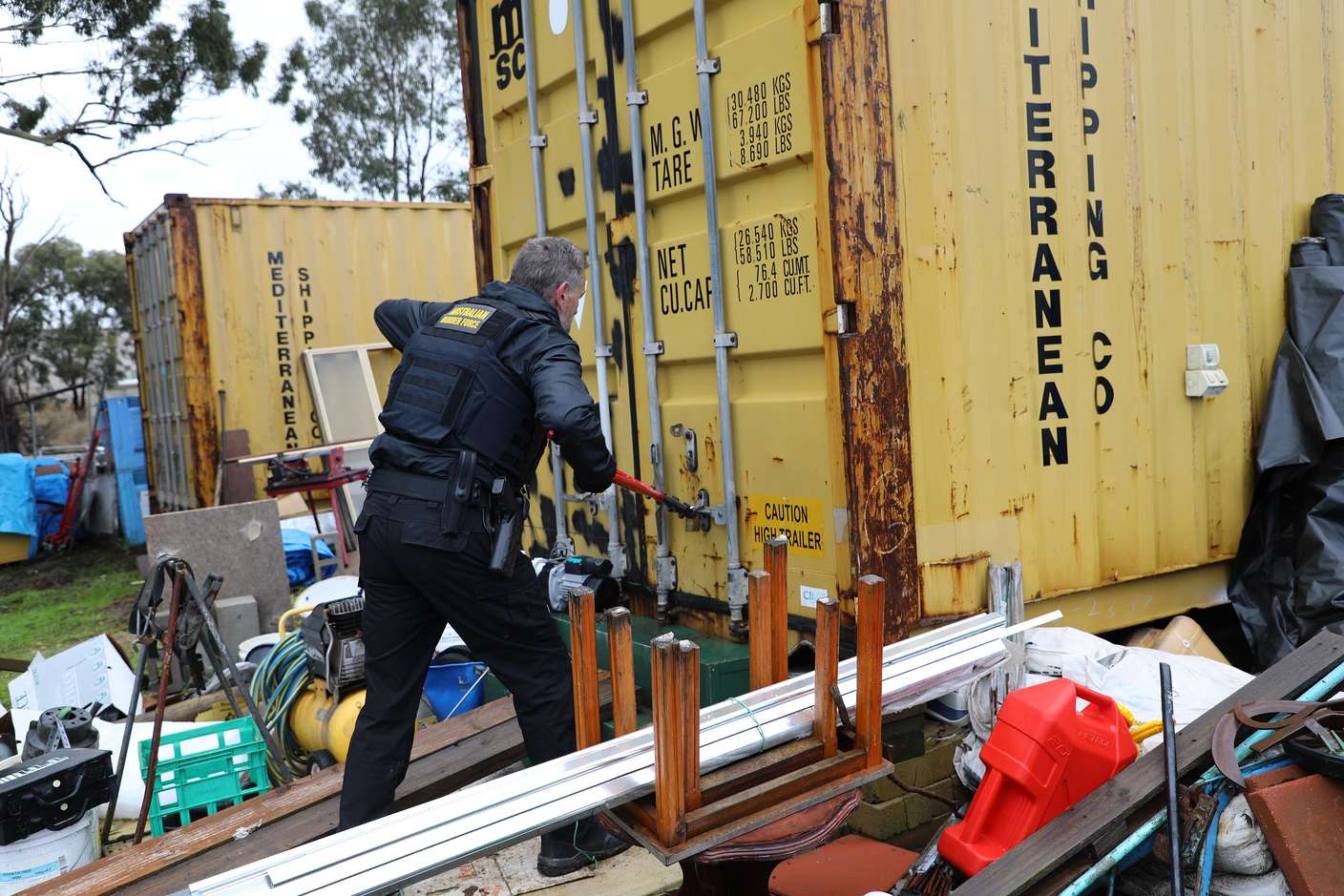
The TGA works with the Australian Border Force to stop unlawful imports, and says that where an import appears unlawful “the goods may be seized and destroyed. You may lose the products and the money you paid” (TGA).
Customs permits for some hormones
Regulation 5G of the Customs (Prohibited Imports) Regulations 1956 prohibits importing a substance in Schedule 7A unless the importer holds written permission from the Secretary of the health department, or an authorised person, and produces it to a Collector. Schedule 7A, as compiled on 13 July 2026, lists:
- anabolic or androgenic substances;
- erythropoietin;
- natural and manufactured gonadotrophins, including human chorionic gonadotrophin;
- natural and manufactured growth hormones, including somatropin and insulin-like growth factors, and “growth hormone releasing hormones (somatorelin and synthetic analogues)”;
- darbepoetin alfa.
The Office of Drug Control, which handles these permits, says anabolic and androgenic substances and certain hormones “require a permit for each shipment entering Australia and for each substance and/or preparation type” (Office of Drug Control). Regulation 5G has a narrow exception for a ship or aircraft passenger’s own prescribed treatment, carried on board, which does not apply to athletes or their support staff. Whether a particular peptide falls within the Schedule 7A wording is a question for the Office of Drug Control.
Once it is here: possession
Clearing the border does not settle possession. Appendix D, clause 5 of the Poisons Standard lists poisons, including BPC-157, TB-500, CJC-1295 and ipamorelin, that “must not be possessed by a person without authority”, and state and territory laws apply the standard. The TGA notes those laws “may impose additional controls on the sale, supply and possession of unapproved peptide products” (TGA advisory).
Penalties
The TGA says importing therapeutic goods without the relevant approval or exemption can lead to seizure and destruction and “significant fines, or civil or criminal proceedings” (TGA). For breaches of the Therapeutic Goods Act more broadly it cites civil penalties of up to $1.82 million per breach for individuals and $18.2 million for corporations, and criminal penalties of up to seven years’ imprisonment (TGA). Enforcement in 2026 has included a seizure of more than $120,000 of illicit peptide and anabolic steroid products from two homes in New South Wales, carried out with NSW Police (TGA peptide hub).
Travellers and athletes
The Australian Border Force traveller guide sets out which medicines and substances can be brought into the country and which need permission first. Athletes face a second set of rules: Sport Integrity Australia warns that possession of prohibited peptide products by athletes can itself be an anti-doping rule violation (Sport Integrity Australia).
Peptide Testing Australia’s article on import, possession and supply rules covers the same ground from a different angle.
Questions readers ask
Can I take peptides into Australia?
Only if the import meets every condition of the law that applies. For prescription-only peptides under the Personal Importation Scheme that includes a valid Australian prescription at the time of import and no more than a three-month supply, and some hormones also need a Customs permit.
Can peptides be seized at the border?
Yes. The TGA says goods that appear to be unlawful imports may be seized and destroyed, with the loss of the product and the money paid, and that vials labelled only with codes will not be considered for release.
Do I need a permit to import hCG?
Human chorionic gonadotrophin is listed in Schedule 7A of the Customs (Prohibited Imports) Regulations, so importing it requires written permission under regulation 5G, subject to a narrow exception for a passenger’s own prescribed treatment.
Does ‘research use only’ make importing legal?
No. The TGA says such disclaimers do not change a product’s regulatory status, do not permit importation and do not remove advertising or supply obligations.
Sources
- TGA: How we regulate therapeutic peptide products
- TGA: Personal Importation Scheme
- TGA safety advisory, 13 April 2026: responsibilities for unapproved peptide products
- Customs (Prohibited Imports) Regulations 1956
- Office of Drug Control: importing anabolic and androgenic substances
- Poisons Standard, October 2026 (F2026L01327)
- TGA safety advisory, 14 September 2026: counterfeit retatrutide
- TGA: Peptide products
- Australian Border Force: medicines and substances
- Sport Integrity Australia: Peptides explained